

Resources for Services
A resource represents everything needed to carry out a certain service offered by the company. For example, in an associated medical clinic, resources could be the rooms used for consultations, diagnostic machines, etc., while in a gym, resources could be rooms for classes or equipment used during them (e.g., spinning bikes).
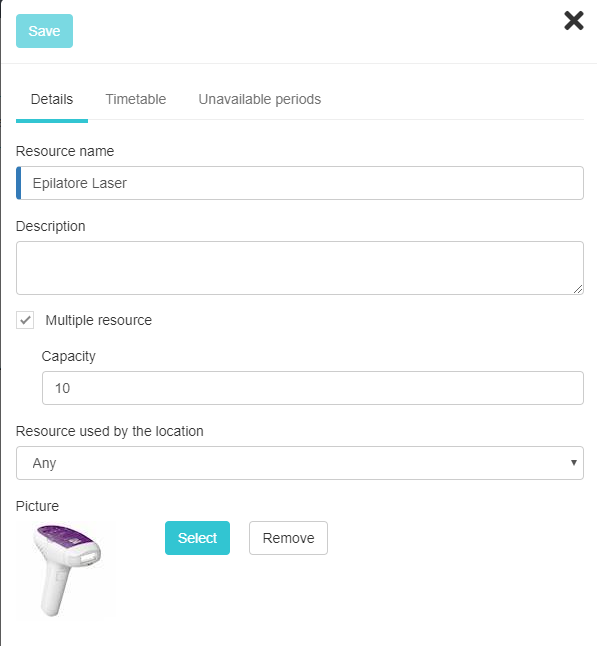
Resources can have a multiplicity, representing the number of available resources of the same type. For example, a physiotherapy center may have multiple Tekar therapy or Iontophoresis machines, allowing the same service to be provided to multiple patients simultaneously.
The multiplicity of a resource plays a key role when assigning appointments: the system will only allow assigning the same service to different patients at the same time if sufficient resources are available.
In the physiotherapy example, three simultaneous appointments for Tekar therapy can only be scheduled if the multiplicity of the resources used in the service (rooms and Tekar machines) is at least three.
Similarly to services, it is possible to assign a color to visualize appointments using a specific resource.
Another important aspect in a multi-location scenario is associating a resource with a particular Location. Usually, a resource is associated with only one specific location because it is only available there, but in some cases, the same resource may be used at multiple locations. For example, a company that rents vehicles may have multiple pickup points (locations) across the city. The resource “Fiat 500 vehicle” should be available for booking at any location.